Red Rooster confuses me. The stores I notice often look quiet, some look like they have been waiting years for a renovation, and yet there always seems to be another one. Big-city suburbs, smaller towns. Apparently everyone knows where Red Rooster is. I just seem to miss them going there.
Admittedly, driving past a restaurant is not a particularly thorough financial investigation. But the combination is interesting: a business can look underwhelming from the road while maintaining a substantial network. What keeps those stores worth operating?
The evidence points to a business that has put work into how customers order and what its kitchens sell, supported by a franchise structure that spreads ownership across local operators. The tired shopfront was what caught my attention. It turns out to be a fairly limited place to start judging the business.
The customers leave with the evidence
Red Rooster lets customers order and pay through its app or website, then collect through the drive-through. It also offers delivery and takeaway. Several people can buy dinner without anyone settling into a chair.
That makes the dining room a poor guide to the kitchen's workload. A customer eating inside remains visible for the duration of their meal. Someone collecting an order leaves almost immediately. The same spending can produce very different impressions of how busy the restaurant is.
Red Rooster has actively developed those options. Its 2023 franchise brochure described kerbside pickup, kiosks, QR ordering and integration with delivery platforms. It also outlined a focus on accessible, high-traffic locations and restaurant layouts accommodating different collection methods. Convenience was part of the investment plan.
This does not establish what proportion of sales comes through each channel today. But it gives us a more convincing explanation than assuming every customer has collectively agreed to avoid being seen.
One store listing provides a useful sense of scale. Advance Business Brokers advertised a Red Rooster drive-through 39 kilometres from Perth's CBD with FY2025 turnover of $1.6 million. That is a broker's sales claim about one business, not independently verified accounts or an average for the chain.
Spread across 365 days, it works out to roughly $4,400 a day. If we assume a $30 average order purely for illustration, that would be about 146 orders daily, across every way of buying. Neither the assumed order value nor the trading-day count is reported store data.
The point is that annual turnover can accumulate without a restaurant looking permanently packed. Those orders will cluster around meal times, and every dollar still has costs attached. But the absence of people sitting down with a tray tells us surprisingly little about the total passing through the till.
The roast chicken business added another reason to visit
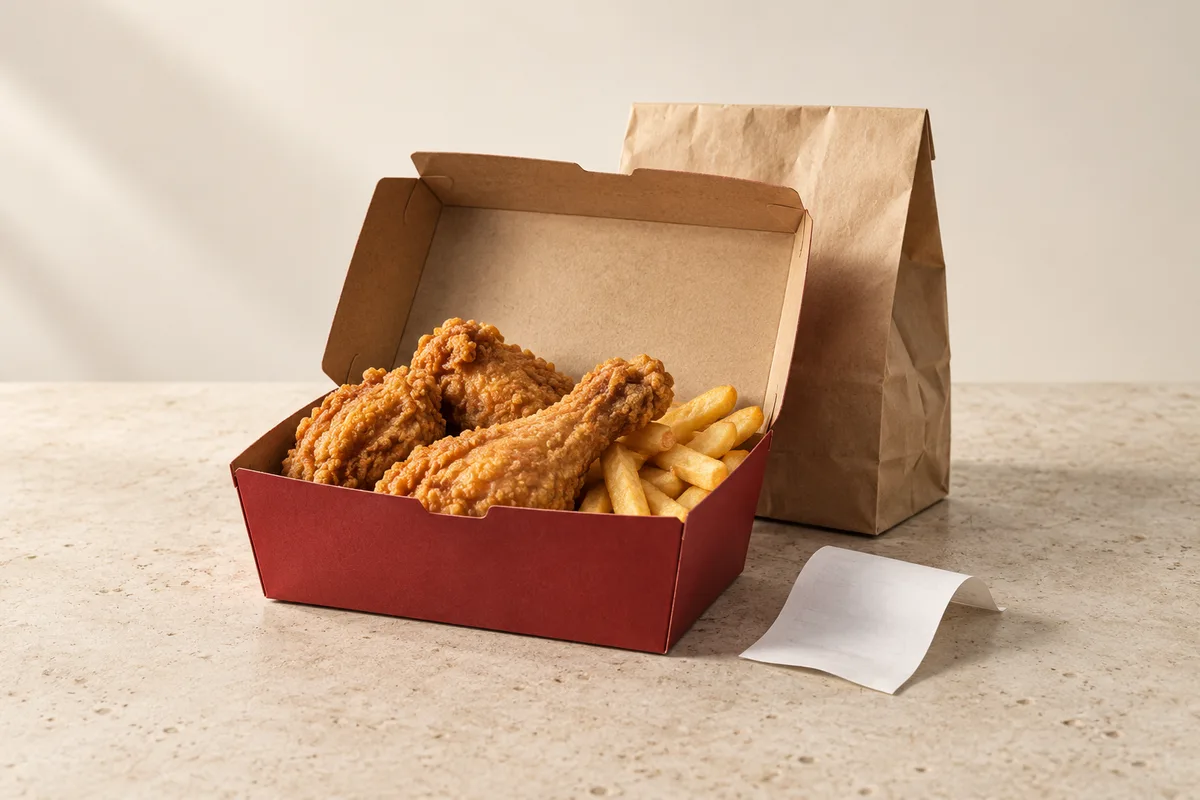
In 2021, Red Rooster introduced fried chicken alongside its roast offering. Its franchise brochure explicitly described the addition as a way to broaden the menu and attract more customers. This gave an existing restaurant another meal to compete for, using a location people already knew.
There was practical work behind that change. Equipment supplier Henny Penny documents high-volume fryers, holding equipment and training through its Australian distributor, J. L. Lennard. The kitchens needed to cook bone-in chicken consistently, recover temperature between batches and manage oil consumption.
These are less exciting subjects than a rebrand, but they affect whether selling the food is worthwhile. A new product has to work during a rush, fit into the kitchen and leave enough money after preparation and ingredients. Looking good on a menu board is the easy part.
For an established restaurant, an additional order can help cover rent and other expenses it already carries. The attraction is being able to sell more from the same address, provided the extra spending on equipment, labour and ingredients is justified. A customer who previously went elsewhere for fried chicken is potentially more valuable to this strategy than an existing customer simply swapping their usual meal.
That also explains why menu expansion is not automatically a success. If the new product mostly replaces existing sales, the business may have made its kitchen more complicated without attracting much additional spending. The supplier's account establishes what changed operationally; it does not give us an audited profit uplift.
Still, the documented changes challenge the idea of a chain simply doing the same thing indefinitely. Whatever impression a particular building gives, Red Rooster has changed the offer inside it.
One brand, many business owners
Red Rooster describes its restaurants as businesses owned and operated by local franchisees. Behind the shared name are operators with their own investment, expenses and reasons for keeping a particular store open.
They buy access to an established brand and operating system, accepting fees and restrictions in return. That can save an owner from having to develop every process themselves, but it also means they cannot run the place entirely as they please. Buying a business and discovering that someone else still has plenty of instructions for you is very much part of the arrangement.
Craveable Brands, the group behind Red Rooster, described training, coaching and oversight of locations and leases in its 2019 submission to the Franchising Taskforce. It also explained its reliance on royalties generated through the franchise network. The local business sells meals; the franchisor earns revenue through its relationship with the operators.
This structure helps explain how a brand can have a wide footprint without centrally owning and operating every restaurant. Investment and daily management are spread across franchisees, while the network supplies common systems and support. It does not make the underlying costs disappear. It allocates them.
The operator still needs enough left after expenses to justify their work and investment. A restaurant generating revenue for the wider network can nevertheless provide a disappointing return to the person running it. As the ACCC points out, franchisees carry financial risk, including the possibility that the business cannot cover its costs.
For that reason, the chain's continued existence is not a recommendation to buy one of its stores. A recognisable name gets you recognised. It does not pay your rent.
About that renovation
An older-looking restaurant invites an easy explanation: perhaps the building is paid off, perhaps the rent is cheap, perhaps the owner owns the land. Those things require evidence. Faded paint does not tell us what is in the lease.
What it does raise is the question of where an operator should put their next dollar. A refurbishment has to be considered against its cost, any disruption and the business it might attract. If customers mainly collect their meals, improving ordering or kitchen performance could be more useful than replacing the dining-room furniture.
Red Rooster's investment in ordering options and cooking equipment gives us actual examples of spending beyond the shopfront. Its brochure also described refreshed restaurant designs, so this is not a claim that the company has abandoned renovations. The practical question is how each kind of investment improves a particular store.
An established restaurant also faces a different decision from a new development. Continuing to use a functioning kitchen does not require the same initial outlay as building another one. That can make continued operation worthwhile even when a brand-new version of the business would be difficult to justify at today's setup costs.
However, continuing to trade and earning a sufficient long-term return are not the same thing. Equipment wears out, leases expire and neglected premises can drive customers away. An operator who can pay this month's bills but cannot afford the next necessary refit has a problem waiting for them.
So, how is it still here?
My conclusion is that Red Rooster has more going on than its quieter dining rooms suggest. It has developed ways to sell meals without filling tables, expanded what existing kitchens can offer and built a network in which local franchisees operate under shared systems. Those are concrete commercial mechanisms, even if they are not particularly obvious through a car window.
That makes the business easier to understand. It does not establish that every location is healthy, or that a dated store is secretly making a fortune. Current store-level profits and a reliable breakdown of sales channels would be needed to go further.
The test I would apply is whether a store produces enough after its costs to pay the operator properly and fund the work needed to keep trading. That is more demanding than simply keeping the lights on, and far more useful than counting empty chairs.
I am still not convinced about some of the interiors. I am considerably less convinced that they tell me whether the chicken is selling.
Sources
Company materials, supplier evidence, a broker listing and regulatory guidance. Links checked 6 September 2026.
- Red Rooster: Click & Collect Drive-Thru
- Red Rooster: ordering and delivery
- Craveable Brands: 2023 franchise brochure, especially pages 6–7
- Advance Business Brokers: Red Rooster drive-through listing, reference RRBY
- Henny Penny: Red Rooster struts onto the fried chicken scene
- Red Rooster: About us
- Craveable Brands: submission to the Franchising Taskforce, 25 November 2019
- ACCC: Before you sign a franchise agreement and buy the franchise