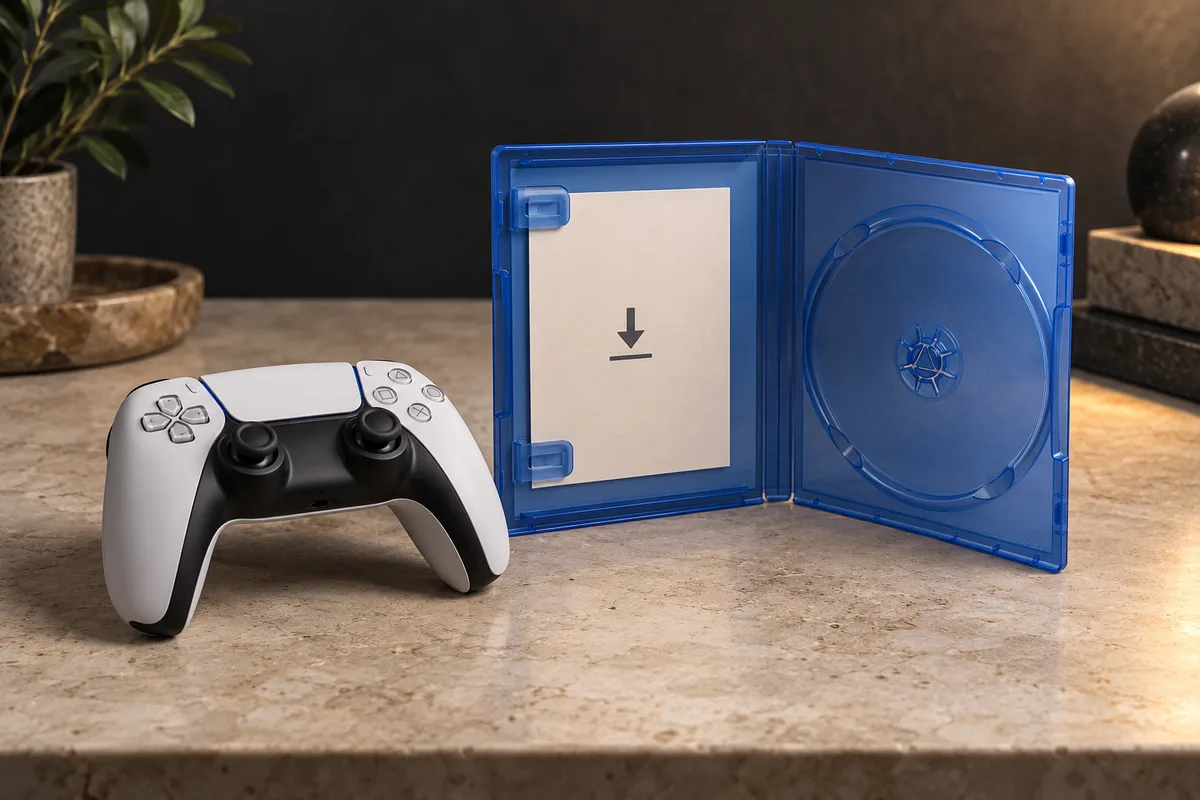
You will be able to buy a physical copy of GTA VI that does not contain a disc. Rockstar says the box will contain a download code instead. After all that waiting, the physical edition is apparently the box.
You can put it on your shelf. You can admire the artwork. Hand it to a mate after redeeming the code, though, and you have mostly given them a storage problem.
That is Rockstar’s decision for its announced boxed release, rather than a restriction exclusive to PlayStation. But Sony is heading further in the same direction. From January 2028, new PlayStation releases will be available in digital formats only, through PlayStation Store and retailers. Existing disc releases are unaffected.
Sony says it is following consumer preferences, which is reasonable enough. Downloading a game is convenient. Changing games without getting off the couch is convenient. Discovering that the disc you want is inside a completely unrelated case is less convenient.
But the disc did something useful after the original purchase. Removing it changes who gets paid when the next person wants to play.
A game could pay for part of the next one
A physical game can have several owners over its life. Someone buys it new, finishes it and trades it in. A retailer sells it second-hand. The next person plays it without buying another newly issued copy.
That gives the original customer something to recover.
Imagine buying a game for $100 and selling it later for $40. Ignoring selling costs, playing it has cost you $60. Buy a digital copy for the same $100 without an equivalent resale option and the full amount stays spent.
These are illustrative figures, but they expose the problem with comparing purchase prices alone. Two versions can cost the same at checkout while leaving you with different options afterwards.
For a publisher, the second-hand copy can compete with a new sale without generating another new-copy payment. For the buyer, that competition can be useful. You might wait for a used copy, borrow one or sell something you have finished to fund the next purchase.
Removing the disc makes those alternatives harder to access. A redeemed code does not acquire another use because you put it back in the box.
That does not mean every second-hand buyer becomes a full-price customer. Some would wait for a sale or buy another game. Others would simply not bother. Publishers cannot assume everyone declining to spend $100 was desperately looking for fewer alternatives.
Still, reducing second-hand supply can favour new purchases. It is a commercial benefit worth considering alongside the convenience.
You choose the console once
The PS5 Digital Edition arrives without a disc drive. Compatible slim models can add a separately purchased drive, although that does not apply to every Digital Edition ever sold. Sony also requires an internet connection to pair the add-on drive during setup.
Without a drive, a cheap disc is not a bargain available to you. Neither is a friend’s old collection.
That makes the hardware price only part of the calculation. A console can cost less upfront while restricting how you buy games for the next several years. Whether that saves money depends on what you would otherwise buy, the offers available and whether you would sell anything afterwards.
For someone who buys everything digitally and keeps it, a drive might offer very little value. Digital discounts can be attractive, and plenty of people do not want to organise a second-hand sale every time they finish a game.
But if you regularly trade games in or buy used copies, those options belong in the comparison. A saving on the console should be weighed against the purchases it commits you to making later.
Sony’s announced transition does not eliminate retailers either. Its statement specifically includes digital formats sold through shops. The argument is therefore more complicated than Sony becoming the only place you can pay.
A retailer can still sell you a code. What changes is the product you have left after using it.
What does “owning” the game actually mean?
PlayStation’s Australian software terms describe its software as licensed rather than sold. That distinction applies beyond downloads. Buying a disc never gave you ownership of the game’s intellectual property.
You could not buy Gran Turismo and start releasing your own sequels. Fair enough.
But that is probably not what most people mean when they say they own a game. They mean they paid for a copy and expect some control over it: keeping it, playing it later, handing it to someone else or recovering some money when they are finished.
A physical copy makes some of those things possible in ways a redeemed digital purchase generally does not. The distinction is useful even though both involve software licences.
Discs have their limits too. A particular game may still need downloads, updates or online services. Keeping the disc does not guarantee that every feature will remain available forever. Digital purchases also vary: buying a game outright is different from accessing it through a subscription, and downloading it does not automatically mean you must stay online whenever you play.
The practical question is what access depends on. Is the necessary software on the disc? Does the game need a server? Is your entitlement attached to an account? What happens if you lose access to that account?
Those are more useful questions than stopping at the word “buy”. They tell you what you are paying to keep, and what still relies on someone else continuing to provide it.
Australian consumer protections do not disappear because the transaction involves a licence. PlayStation’s own terms recognise the priority of mandatory consumer laws. But having legal protections and having a copy you can physically pass on are different benefits.
Xbox wants your collection to come with you
Xbox has announced a different approach to existing discs. Its August announcement introduced an Insider feature allowing supported Xbox One and Xbox Series X discs to unlock digital access, while the physical discs continue working. Not every title is included, and additional features depend on support.
That is not a promise of GTA VI on disc. It is an offer to make supported games people already have useful in more ways.
There is an obvious appeal to that. If you have spent years building a collection, you would quite like the next stage of gaming to acknowledge it exists.
Microsoft has a reason to care as well. A useful collection gives you a reason to remain with Xbox. Moving platforms becomes a larger decision when it involves leaving purchases behind, keeping old hardware around or buying games again.
Preserving access can benefit the player and strengthen the platform’s position at the same time. Microsoft does not need to be doing it purely out of affection for your bookshelf.
That is the competitive opportunity: convince people that the money they have already spent will remain useful with you. Their previous purchases then help influence where the next ones go.
The saving needs to survive the next purchase
Digital distribution removes the need to manufacture and transport an individual disc for each copy. Customers get faster access and less physical clutter. Those are real advantages.
The platform can also benefit from a customer whose growing collection remains tied to its services, while publishers face less competition from copies circulating between players. Convenience and commercial control can arrive in the same transaction.
My view is that digital games should be judged on the full deal. A discount is useful. So is resale value. So is the ability to choose between new and used copies, or keep using a collection without replacing it.
If you never use those options, giving them up may be an easy decision. If you do, they have value even when the checkout does not assign them a price.
That is why a cheaper console or an easier download does not settle the comparison. You need to consider what the arrangement costs across the games you buy, keep and move on from.
PlayStation gains when more of that spending stays within its platform. The customer should get enough in return to justify the options they lose.
Keeping the box is a fairly modest concession.
Sources
Primary announcements, hardware details and Australian software terms checked on 13 September 2026. Resale figures are illustrative.