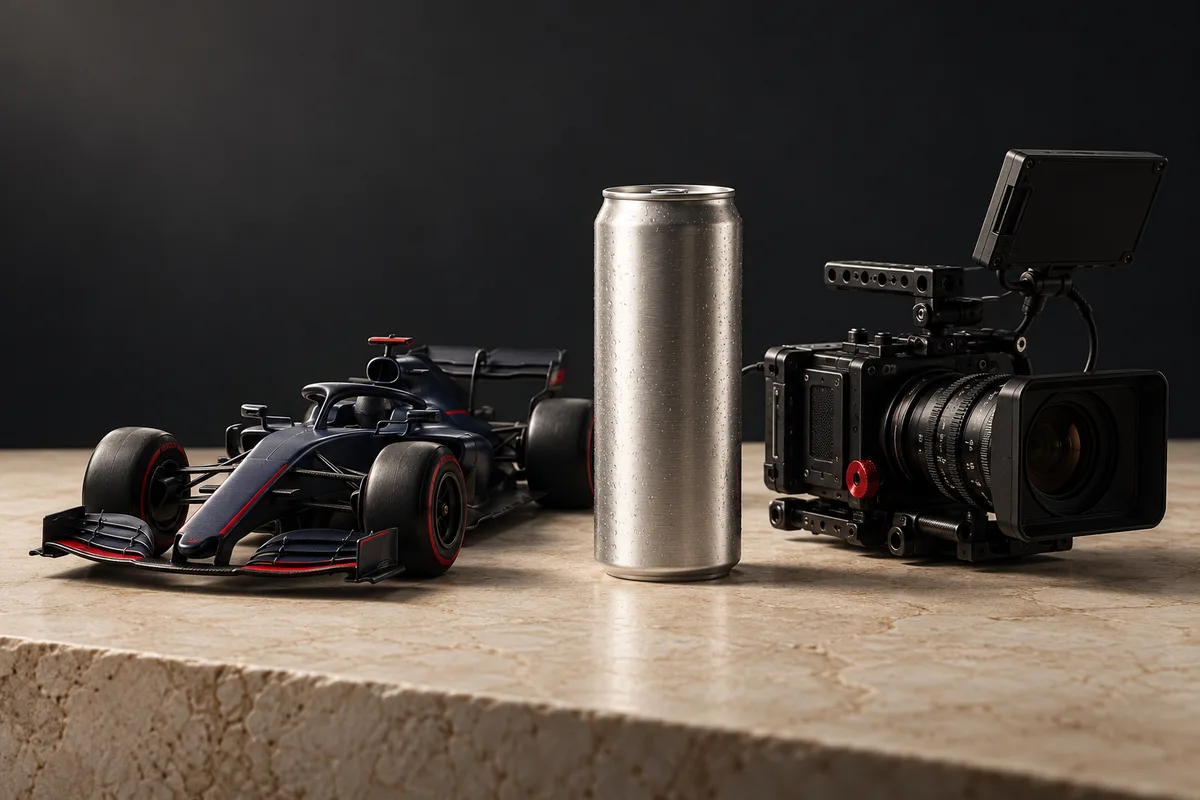
Red Bull sells an energy drink. It also has a Formula 1 team and helped send a man to the edge of space.
There are probably cheaper ways to remind people you are available at the servo.
Yet treating everything outside the can as an extravagant advertising expense misses part of the arrangement. Red Bull has built businesses and events that attract audiences, produce things people want to watch and give other companies somewhere to advertise.
It can promote its own brand while selling access to the attention it helps create.
The drinks remain a fairly substantial part of the story. Red Bull says it sold almost 14 billion cans in 2025 and reported group turnover of €12.196 billion. Calling it a media company that happens to sell drinks rather understates the amount of drinking involved.
The more useful question is what owning the entertainment gives Red Bull that buying an ad does not.
Buying the team changes the arrangement
When a company sponsors a team, it negotiates for particular rights. Those might include its logo on a shirt, access to players, hospitality or permission to use the association in advertising. The team already has something people care about, and the sponsor pays to become connected to it.
Buying the team changes the relationship. The company now has an ownership interest in the organisation attracting that attention, along with the responsibility and expense of running it.
Red Bull bought Jaguar’s Formula 1 team in 2004 and entered the following season under its own name. It acquired the operation behind the cars, rather than simply another place to put a sticker.
That gives the brand a place in the competition’s ordinary conversation. Someone discussing how Red Bull performed in qualifying is using the company’s name because it identifies the team. The association continues through results, interviews and arguments about race strategy.
The audience does not need to stop watching the sport to encounter the brand.
Ownership also provides a longer-term interest in whatever gets built. A sponsorship can expire, leaving the sponsor to negotiate again or find another property. An owner retains its stake in the organisation, including the possibility that it becomes more valuable.
Of course, it also retains the organisation when things go badly. Buying a racing team is quite a commitment to avoiding a media booking fee.
Red Bull uses different arrangements in different places. Its 2024 Leeds United deal combined shirt sponsorship with a minority ownership stake. Leeds expressly said its name and logo would remain unchanged. That is a different level of control from owning and naming a team, even if the same bulls appear on the kit.
Seeing the logo tells you there is a commercial relationship. It does not, by itself, tell you what Red Bull owns.
Other brands can pay to join in
The arrangement becomes particularly interesting when other brands join in.
Oracle is the title partner of Oracle Red Bull Racing, with a further multi-year extension announced in February 2026. The relationship includes technology used in the team’s operations as well as the public association between the two businesses.
Red Bull’s team therefore gives another company something worth partnering with. The energy drink brand remains embedded in the team’s identity, while the team can offer commercial rights to others.
Red Bull Media House makes a similar proposition more explicitly. It offers outside brands partnerships involving events and integration into content productions, with access to Red Bull’s audience forming part of the offer.
A company that might otherwise buy advertising can become a seller of advertising opportunities itself.
That does not establish that every event or team pays for itself. It does establish that the commercial opportunity extends beyond hoping someone remembers the can next time they open a fridge.
The footage has a life of its own
There is also a production business behind the spectacular bits.
Red Bull Media House lists advertising, production, distribution and licensing services. Red Bull Studios has a stated mandate to fund, produce and distribute film and television programming. These are activities with customers and deliverables of their own, rather than simply a social media account operating with an unusually generous travel budget.
Producing an event can create material for several uses. There is the live experience, the broadcast, the highlights and potentially a longer story about the people involved. Depending on the rights held, footage can keep being distributed after everyone has packed up and gone home.
That gives Red Bull more ways to recover value from the same underlying activity. It also creates more opportunities for someone to encounter the brand without watching a conventional product advertisement.
The distribution matters as much as the filming. Red Bull Media House says it works with more than 1,000 distribution partners across television, streaming, digital and film. Owning content is much more useful when there is an established way to get it in front of people.
It still depends on other companies’ platforms, audiences and rules. Owning a film does not mean owning everyone who watches it. But having material that a broadcaster or platform wants gives Red Bull something to negotiate with beyond an advertising budget.
People chose to watch
Red Bull Stratos is the clearest example of how far this approach can go.
In October 2012, Felix Baumgartner’s jump from the stratosphere drew more than eight million concurrent livestreams at its peak on YouTube, according to YouTube’s own account. People deliberately went to watch an event carrying Red Bull’s name.
The achievement was the reason to watch. The branding travelled with it.
That is a much stronger position than interrupting something interesting to explain that your drink contains caffeine. Red Bull helped make the thing people were interested in seeing.
It would still be a stretch to take those viewing figures, place them beside annual sales and declare that the jump sold a particular number of cans. The audience figure measures attention. It does not measure purchases, profit or what would have happened without the event.
The commercial argument is that repeated exposure in these settings can make Red Bull familiar and give that familiarity a particular character. Speed, ambition, skill and doing something most people would sensibly decline become associated with the same name that appears on the drink.
You do not need to participate in any of it to recognise the brand.
Most customers are unlikely to be preparing for a stratospheric jump. Some are preparing for the second half of a shift. The distance between those activities is considerable, but the product can carry the association into an entirely ordinary purchase.
That is where I think the connection to beverage sales is strongest. The entertainment gives people reasons to recognise and remember Red Bull before they are choosing a drink.
It does not need to explain the ingredients every time. It gives the brand an identity that competing on ingredients alone would struggle to reproduce.
Attention still has to justify the cost
There are two separate commercial tests here. Can a team, production or partnership generate enough revenue to justify its costs? And does its association with Red Bull help the wider brand enough to justify any additional investment?
Both can matter. Combining them carelessly makes it very easy to describe any expensive project as brilliant marketing.
The public figures used here do not provide a clean answer for every part of the group. Group turnover is not a breakdown of media profitability, and a sponsorship announcement does not reveal the full cost of running the team receiving it.
There are also limits to how much ownership helps.
An owner can influence investment, staffing and strategy. It cannot order the audience to care. Sporting results remain uncertain, productions can disappoint and a close association means reputational problems can travel back to the drinks brand as readily as success does.
Nor does spectacular content remove the ordinary work of selling beverages. The product still needs to be available, priced attractively enough and something people want to buy again. A memorable video is of limited assistance if the fridge only stocks a competitor.
What makes Red Bull difficult to copy is the amount that has to work together. Buying a camera or sponsoring an athlete is relatively straightforward. Building the relationships, production capability, distribution and recognisable identity around them takes longer.
A competitor could spend heavily on one impressive event and still emerge with little more than an impressive event. Red Bull has a broader set of businesses and relationships through which that attention can keep circulating.
For most businesses, buying sponsorship will remain considerably more sensible than owning the sport. Red Bull’s model brings control and additional commercial opportunities, but also costs and responsibilities that an advertiser can usually leave with someone else.
Its achievement is making those responsibilities serve more than one purpose. A team can compete, attract partners and carry the drinks brand through the sporting calendar. A production can entertain, be licensed and strengthen the association people have with the company behind it.
The audience has to get something worth watching out of the arrangement. Otherwise, Red Bull has simply made a very expensive ad.
And nobody is sitting through qualifying because they want to learn more about the ingredients.
Sources
Primary sources checked on 11 October 2026. Sales and group turnover refer to 2025. The brand effects discussed are commercial analysis, not measured sales attribution.