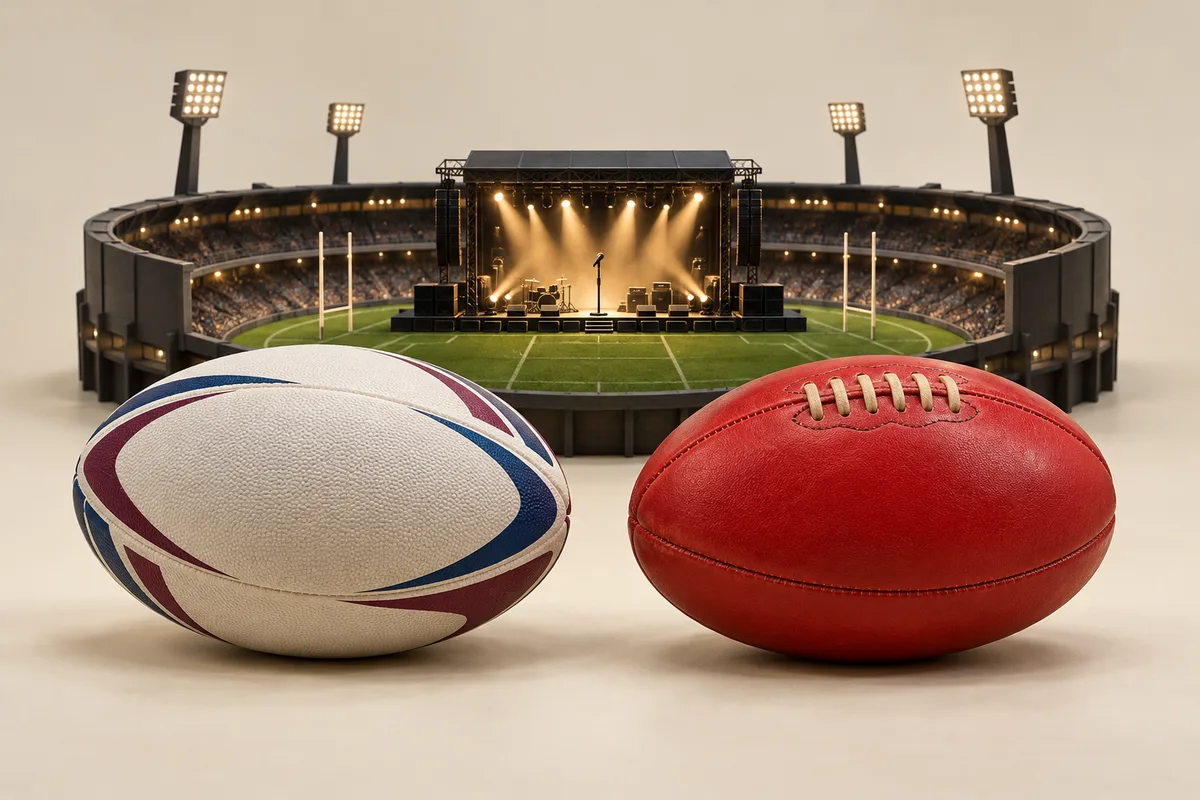
I went to the NRL Grand Final this year and watched the mighty Roosters win. Father Tedesco delivered. No complaints about that part of the evening.
The pre-game entertainment gave me considerably less to celebrate.
Sitting there, I wondered how the AFL ends up with someone like Snoop Dogg while I’m waiting for the music to finish so the footy can start.
That is obviously a matter of taste. Amy Shark, Dave Gleeson and Phil Jamieson, who performed before the NRL decider, have established careers. My lack of enthusiasm does not make them unknown artists. The program also included a tribute to people living with motor neurone disease, which served a different purpose from booking a headline concert act.
But it raised a commercial question worth asking.
What does a footy competition actually get for spending serious money on a few songs before kick-off?
The NRL had already asked that question
This year’s entertainment followed the collapse of negotiations with Tones and I.
In September, ARL Commission chair Peter V’landys told the ABC that he would prefer to direct money towards helping children participate in rugby league than spend $1 million on an 11-minute performance. He put the total cost of such performances at close to that amount and argued that people attended for the footy.
That was his explanation of the choice. It does not establish the final cost of the replacement show or how much was ultimately redirected to grassroots participation.
It also suggests the issue was not simply an inability to attract a recognisable performer. The NRL had Teddy Swims at its 2025 Grand Final.
The stronger question is whether the league thinks a major entertainment booking earns its place in the budget.
As someone who would have attended to watch the Roosters regardless, I can see the argument.
They did not need Snoop Dogg to sell me on watching Mark Nawaqanitawase do something inhuman to get a ball over the try line.
The AFL is selling something beyond the match
Snoop’s AFL appearance was in 2025, so this is a comparison of approaches across different seasons, rather than a claim that he performed opposite this year’s NRL show.
The AFL’s announcement explained its ambition quite openly: a Grand Final celebration extending beyond the footy into music and entertainment. Telstra was the presenting partner, Mushroom produced the performance, and the announcement also credited Seeker Agency’s involvement in securing Snoop.
That is a commercial production involving several parties, not just someone at AFL headquarters deciding they like a particular song.
A globally recognised performer offers ways to draw attention from people who do not follow the sport. Someone might ignore a week of footy coverage but watch a clip of Snoop at the MCG.
His appearance also created material before the performance itself. The AFL’s website carried coverage of him kicking goals with the Daicos brothers and sharing his own footy card on Instagram.
The booking therefore produced more than a short set on Grand Final day. It provided publicity, social content and opportunities to put the AFL in front of a different audience.
Whether that attention justified the cost is another question. But counting the minutes on stage misses part of what was being purchased.
A sold-out stadium is only one part of the audience
If the game already sells its tickets, a musician may contribute little to attendance.
That does not necessarily make the booking pointless. It changes where the return needs to come from.
For the broadcaster, an act could encourage people to tune in earlier or keep watching through the lead-up. For the league, it could introduce the event to casual viewers. For a sponsor, it could create a recognisable moment around which to build a campaign.
These are possible benefits, not proven results from this particular booking.
Telstra’s presence is relevant because a sponsor can value the association independently of whether the performer sells another match ticket. The AFL’s announcement prominently connected Telstra with the show. It did not disclose the financial split between the parties, so we cannot assume who paid which bill.
From that perspective, the question becomes more specific: what additional attention or commercial value does the performer create, and who is prepared to pay for it?
The answer could justify an expensive act.
It could also reveal an expensive act with a very enthusiastic press release.
The ratings cannot answer everything
Suppose millions of people watch a pre-game performance. That sounds impressive, but many may already have been watching because the Grand Final was about to start.
The useful number is how many viewers the entertainment added or retained compared with a credible alternative.
The same caution applies to social media. A clip getting attention does not establish that its viewers became footy supporters, bought tickets or made the sponsorship more valuable by an equivalent amount.
Comparisons between the AFL and NRL also need to account for scheduling, participating teams, broadcast availability and how audiences are measured. A larger match audience does not prove the musician caused it.
That makes the spending decision harder than comparing two ratings figures. It does not make evaluation impossible.
A league could examine audience changes during the program, sponsor contributions, engagement outside its usual audience and whether the booking helped sell commercial packages. It should also compare those outcomes with what a less expensive show could achieve.
The relevant alternative is not necessarily silence until kick-off.
Grassroots funding is a serious alternative
V’landys’ argument has substance because money spent on entertainment is money unavailable for something else, unless the booking brings in enough additional funding to cover it.
Helping people participate can benefit families and strengthen the sport over time. A performance might produce more immediate attention. Both can serve commercial and community objectives, but on different timelines.
That makes “footy or a pop concert” a slightly incomplete way to frame the choice.
If a sponsor will fund a substantial part of a show because it attracts a wider audience, cancelling it may not release the same amount for grassroots spending. Equally, if the league carries most of the expense and cannot demonstrate much additional benefit, a cheaper program may be sensible.
The funding arrangements matter as much as the artist’s name.
There is also the experience of the people who paid to attend. Even if they would buy a ticket anyway, delivering a memorable event has value. A sold-out stadium should not be an excuse to stop caring about what happens inside it.
I still wanted a better show
My reaction at the ground was straightforward: I thought the pre-game entertainment could have been better.
The research makes me less convinced that the explanation is simply “the AFL can afford big names and the NRL can’t”. This year’s NRL decision followed failed negotiations and an expressed preference about spending. The AFL’s Snoop booking formed part of a broader entertainment and sponsorship production.
My view is that a major act can be worth the money when the league knows what it wants from the booking and can make a credible case for the return.
Fame alone is not that case. Neither is dismissing entertainment because committed supporters already love the footy. The potential audience includes people who do not yet care as much as we do.
I would like the NRL to aim for a show that feels worthy of its biggest night, with a budget it can justify.
Father Tedesco handled the footy. He shouldn’t have to carry the whole evening.
Sources
Sources checked on 18 October 2026. This compares the 2026 NRL entertainment decision with the AFL’s 2025 Snoop Dogg booking. Commercial benefits discussed are analysis, not measured returns.