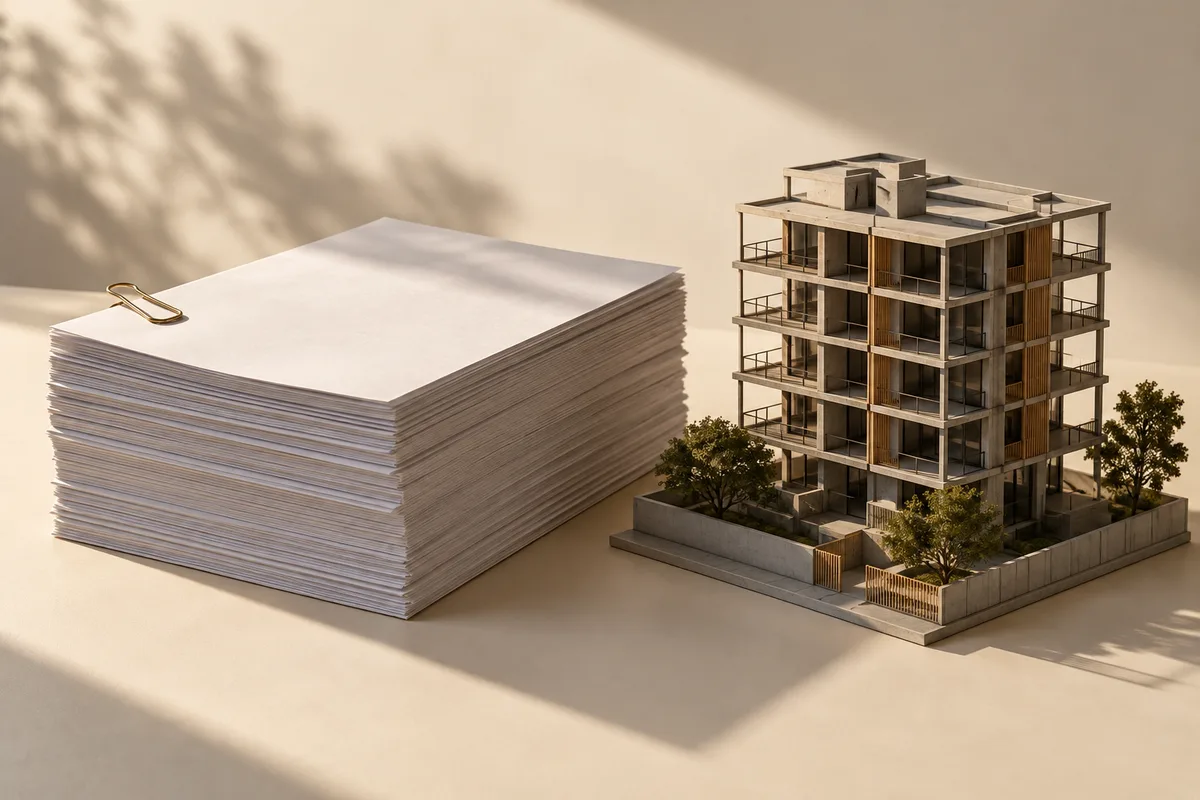
Some of the off-the-plan contracts I come across at work run to around 500 pages. For that much reading, you’d hope the ending involves getting the apartment.
Between the contract, disclosure material and plans, there is a lot to get through before you can confidently explain what someone is signing.
Somewhere in there is the answer to a fairly reasonable question: what happens if they don’t finish building it?
You might expect a deadline to make that straightforward. Then you get to the sunset clause.
Depending on the contract and the law applying to it, that clause can give a buyer a way out of a project that has taken too long. It can also give a developer a right to terminate. The QBCC describes these as rights arising in defined circumstances, rather than an automatic entitlement for either side to leave whenever construction is late.
That becomes particularly interesting when the property is worth considerably more than it was when the buyer signed.
First, which deadline are we talking about?
Buying off the plan means committing to a property before it is finished or, in the case of a proposed land lot, before it is registered.
An expected completion date helps you imagine when you might move in. A sunset date serves a different purpose: it identifies a deadline connected to a termination right if a specified event has not happened.
The relevant event might concern registration or settlement. The wording determines what must happen, by when, and which party can act. Queensland’s government guidance warns that off-the-plan contracts are not standardised.
So “expected completion next December” and “you can terminate next December” are not interchangeable statements.
You also need to understand any provisions allowing the deadline to move. A date is less useful for planning if you haven’t read the circumstances in which it can be extended.
Otherwise, you might be organising removalists around a date that the contract treats rather differently.
Why have an exit at all?
There are sensible reasons for a contract to deal with a project taking too long.
A buyer should want to know how long they could remain committed. A developer also faces uncertainty while turning a proposal into a completed building. Construction, approvals and finance do not always cooperate with the original timetable.
Early sales are commercially important to the project. The RBA has explained how lenders use apartment pre-sales to reduce development lending risk before providing construction finance. A committed buyer helps demonstrate that there should be revenue when the building is finished.
That does not mean the developer gets to spend the buyer’s deposit freely. It means the signed commitment itself has value.
The buyer helps provide certainty early. In return, they expect to receive the agreed property at the agreed price later.
A termination clause determines when that arrangement can end without reaching the outcome both sides originally contemplated.
The difficulty is that their reasons for wanting it to continue can change.
The same apartment, a very different price
Imagine signing a contract for an $800,000 apartment.
Several years later, the relevant deadline has passed and comparable apartments are selling for $1 million. Assume, purely for this example, that the developer has a valid right to terminate under the contract and applicable law.
The buyer might be perfectly willing to wait longer. Their agreed price now looks attractive.
The developer may have a commercial incentive to end the original sale and seek a higher price. Whether doing so would actually produce a better result depends on construction costs, finance costs and the expense of completing and reselling the property.
There is a potential $200,000 difference between the two sale prices. That is not automatically $200,000 of extra profit, but it is enough to make the termination right worth paying attention to.
This is the concern behind controversial sunset clauses: the buyer accepts uncertainty early, but may lose the benefit of the agreed price if the contract can later be ended.
It does not establish that a particular developer deliberately delayed a project. A genuine construction problem and a rising property market can exist at the same time.
The point is to examine the incentive, then test what the contract and law actually permit.
Queensland has an important distinction
Queensland restricted seller reliance on sunset clauses under the Land Sales Act 1984 through reforms commencing on 22 November 2023.
For contracts covered by those provisions, a seller needs the prescribed notice and the buyer’s written consent, a Supreme Court order, or another route prescribed by regulation. When considering a termination application, the court must examine matters including the seller’s conduct, circumstances beyond its control, the effect on the buyer and whether the land has increased in value.
But those particular reforms do not cover proposed lots in community titles schemes, such as apartments. The Queensland Government’s guidance expressly distinguishes them from the land contracts covered by the reforms.
You therefore cannot read that Queensland “fixed sunset clauses” and assume the same protection applies to every off-the-plan purchase.
That does not give apartment developers unlimited termination rights. Their position still depends on the contract, the applicable legislation and the circumstances. It does mean that identifying the legal framework is part of understanding the purchase, rather than a technical detail to sort out afterwards.
Getting your deposit back may still leave you behind
Return to our hypothetical buyer.
Suppose the contract is validly terminated and their deposit is refunded. They have their original money back, but comparable properties now cost $1 million rather than $800,000.
They have not received the apartment or secured its increase in value. They are shopping again in a more expensive market.
If they also spent the intervening period renting, they may have incurred substantial living costs while waiting. Whether any additional amount can be recovered is a separate legal question. A deposit refund, by itself, does not compensate for every consequence of the delay.
The reverse risk exists too. If values fall and the purchase proceeds, the buyer’s lender may value the finished apartment below the contract price. The RBA identifies this as a reason buyers can need additional funds to settle.
Buying early can work well. But whether the buyer keeps the upside, carries the downside or has a usable exit depends on more than the price in the brochure.
What I would want explained before signing
I would want the person reviewing the contract to explain which event triggers the sunset clause, who can rely on it, what can extend the deadline and what happens to the deposit if the contract ends.
Then I would want to understand the practical position: how long could I be committed, what happens to my housing arrangements during a delay, and could I still finance the purchase if my circumstances change?
Those questions are more useful than simply asking whether the contract is “standard”.
My view is that a sunset clause can serve a legitimate purpose. Projects need a way to address serious delays. But a buyer’s early commitment also deserves weight, particularly where it helped support the project and the market has since moved in the developer’s favour.
A deadline offers limited reassurance until you know what happens when it passes.
Five hundred pages is a lot of reading. Whether you still get the property at the end of it seems worth a few of them.
Sources
Sources checked on 31 October 2026. Queensland law and government guidance checked; the apartment-price example is hypothetical.