I saw Anthony Albanese on Facebook saying card surcharges were being removed. As someone who uses an Amex, I was reasonably pleased with that development.
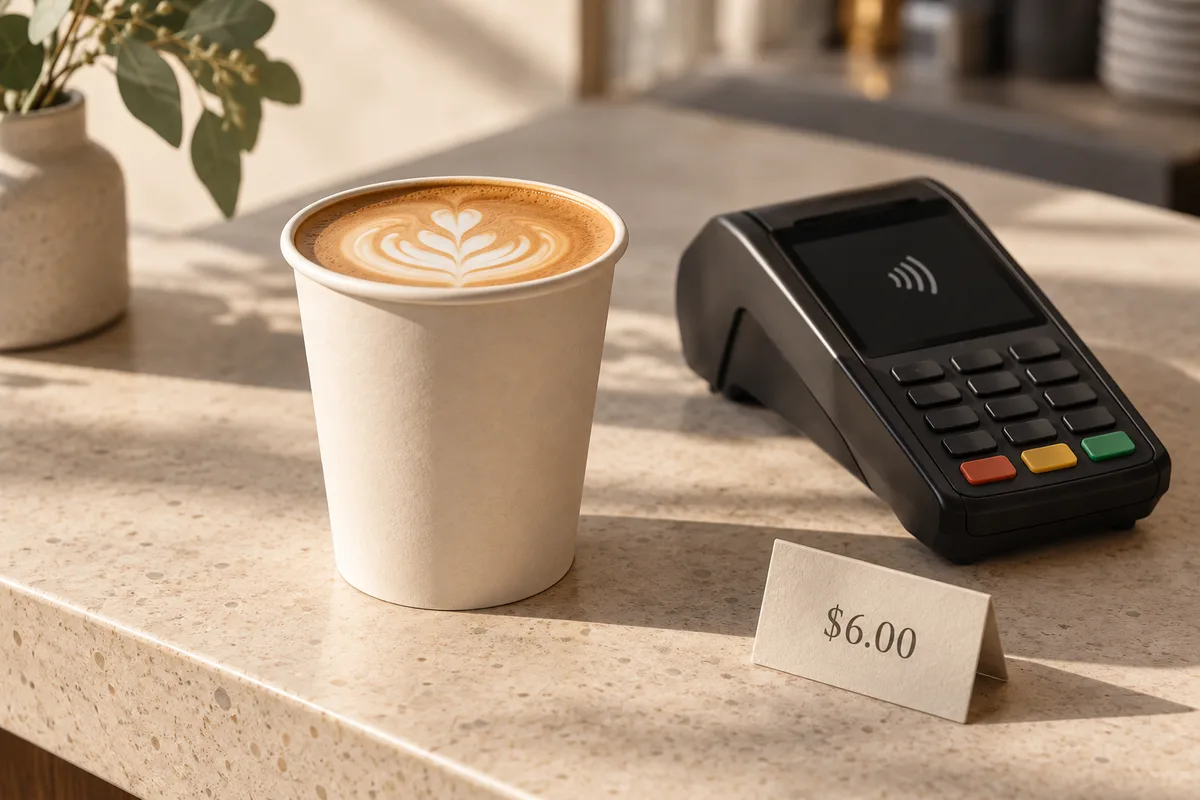
Then my usual coffee went from $5.50 to $6.
The price had been the same since I moved to the Gold Coast. Only now had it changed. Naturally, I had a question: had the surcharge disappeared into the price of the coffee?
Possibly. But noticing two things happen around the same time does not establish that one caused the other. I haven’t seen the café’s accounts or asked the owner what changed.
Still, it raises a useful question. If a business can no longer charge you separately for accepting your card, who pays for accepting it?
The terminal still sends a bill
From 1 October 2026, eftpos, Mastercard and Visa introduced no-surcharge rules after the RBA changed its regulatory framework. American Express also removed surcharging, although it wasn’t covered by that same formal RBA regulation.
That changes what businesses can add to your bill. It doesn’t make processing the payment free.
A café still pays its payment provider. Depending on the arrangement, that can involve transaction charges, terminal rental and other fees. Those costs join the considerably longer list of things the café needs to pay for before the owner gets anything.
Milk. Beans. Wages. Rent. Apparently also the privilege of receiving my money.
The business can absorb the payment cost, negotiate a better deal, reflect it in its overall prices, or use some combination of those responses. The RBA expressly recognises that payment costs can be included in overall pricing.
So there is nothing contradictory about a surcharge disappearing while some prices rise. Whether customers end up better off depends on the total they pay.
Fifty cents deserves a closer look
Suppose a $5.50 coffee previously attracted a 1.5% card surcharge. That is a hypothetical rate, not one I have verified for my café.
The surcharge would be about eight cents, making the total roughly $5.58. A new $6 price is still about 42 cents more.
Removing an eight-cent surcharge does not, by itself, explain a fifty-cent menu increase.
The café might have been holding its price steady while other costs rose. It might have reviewed several costs at once, changed payment arrangements, or simply decided customers would pay $6. The surcharge change could have influenced the decision without accounting for the whole increase.
Which explanation is right? The timing alone cannot tell us.
That is why I wouldn’t turn my coffee receipt into evidence that the entire reform has failed. I would, however, use it to question the assumption that removing a fee guarantees a lower final price.
Who was paying before?
A separate surcharge makes the cost visible to the person choosing the payment method. Build that cost into menu prices and it becomes part of what customers generally pay, including people using cash or cheaper cards.
That can spread costs differently across customers.
There was a reason for allowing surcharges in the first place: a visible extra cost could encourage people to choose a cheaper payment method. But that signal becomes less useful when a business applies the same surcharge across cards with different acceptance costs.
The RBA identified that problem, along with enforcement difficulties and declining cash use, in explaining its decision to change the system.
There is also a straightforward benefit to knowing the actual price before you reach the terminal. Comparing two cafés is easier when the number on the menu is the number you expect to pay.
I would still prefer that number to be $5.50. But at least we are arguing about the same number.
The more useful test
The reforms also lower interchange fee caps and introduce greater fee transparency. Interchange is one component of the cost of accepting cards, rather than the entire bill a business receives.
That gives the reform a second job: reduce the underlying cost, as well as change how it appears to customers.
If a café gets a cheaper payment arrangement, it has more room to hold prices steady or retain some margin. Whether savings reach customers depends on its other costs and how much pressure it faces to keep prices competitive.
My view is that clearer pricing is worthwhile. Removing the surprise at the terminal is a real improvement. But the test of whether something became cheaper is still the total leaving your account.
My coffee now costs $6. I don’t know how much of that has anything to do with surcharges, and I’m not going to pretend otherwise.
In the meantime, I’ll be collecting points on a slightly larger transaction.
Sources
Sources checked on 14 November 2026. The 1.5% surcharge is hypothetical; the cause of the café’s price increase is unknown.